 App Building
How to make a marketplace app (step-by-step guide)
Launch your app faster with Base44. Start now →
Most people think learning how to make a marketplace app requires a development team and months of engineering time. However everything has changed and now AI app builders have made it possible for non-technical founders to go from concept to working product in weeks all without writing a single line of code.
This guide walks you through every step of building a marketplace app: defining your concept, validating your idea, planning essential features, choosing the right build approach, setting up payments and trust tools and launching your first version fast.
Whether you're building a product marketplace, a service platform or an on-demand booking app, the process is the same and creating an app is more accessible than ever.
TL;DR: How to make a marketplace app
A marketplace app connects buyers and sellers (or providers and customers) on a single platform. Building one used to take a development team and a six-figure budget. With AI-powered builders like Base44, you can validate your idea, build an MVP and launch in days or weeks.
| How to build a marketplace app | What to do | |---|---| | 01\. Define your app concept | Choose your niche, buyer and seller types and marketplace format. | | 02\. Choose your monetization model | Commission, subscription, listing fee or freemium. | | 03\. Plan your must-have features | Listings, search, payments, reviews, messaging, moderation. | | 04\. Choose how you'll build it | No-code/AI builder for speed, custom dev for complex needs. | | 05\. Set up payments | Multi-party payouts, KYC for sellers, clear refund policy. | | 06\. Build in trust and safety | Ratings, verified badges, dispute resolution, content moderation. | | 07\. Launch your MVP | Start small, facilitate one transaction, gather feedback fast. | | 08\. Grow both sides | Referral programs, supply-first strategy, track GMV and retention. |
What is a marketplace app?
A marketplace app is a two-sided platform that connects buyers with sellers, or service seekers with providers. Unlike a traditional single-vendor ecommerce store, where one business sells its own products, a marketplace hosts transactions between third parties, with the platform sitting in the middle to facilitate discovery, payment and trust. For a broader look at how this fits into the app landscape, see our guide to eCommerce app development.
The defining characteristic of a marketplace is network effects: the more sellers join, the more valuable the platform becomes for buyers, and vice versa. This compounding dynamic is what makes successful marketplaces so defensible but it also means the early growth challenge is real. Getting both sides active at launch is the hardest problem you'll solve.
Marketplace apps fall into four main categories: B2C (businesses selling to consumers), C2C (consumers selling to each other), B2B (businesses transacting with other businesses), and service marketplaces (where providers offer skills or time rather than physical goods). Each has its own trust requirements, feature priorities and growth mechanics.
What type of marketplace app should you build?
The format you choose shapes everything: your feature set, your monetization model, your trust requirements and how you'll grow. Pick the type that fits your niche and the behavior of your target users.
Product marketplaces
Product marketplaces connect buyers with sellers of physical or digital goods. C2C product platforms let individuals sell to each other. Multi-vendor B2C marketplaces host multiple businesses selling under one roof. Key needs of these marketplaces: strong search and filtering, secure checkout, order tracking, and seller reputation systems.
Service marketplaces
Service marketplaces match buyers with providers who sell skills, expertise, or labor. Freelance platforms, tutoring apps, and legal services networks all fall here. These platforms lean heavily on trust signals such as verified credentials, portfolio displays and structured reviews because buyers can't evaluate the product before they purchase. CRM app development integrations are common in service marketplaces that need ongoing client relationship management.
On-demand and booking marketplaces
On-demand platforms connect buyers with providers in real time so think ride-hailing, food delivery, or home services. Booking marketplaces let users reserve time slots with providers, as with vacation rentals or fitness instructors. Both formats require real-time availability management, location awareness and fast payment processing. The user experience on both sides needs to be frictionless: any delay or confusion at the moment of intent kills conversion.
How to validate your marketplace idea before building
Most marketplaces fail because of business model problems, not tech and how they're built issues. Validating before you build saves months of effort and thousands of dollars. The goal is to confirm that real people want what you're offering and that they'll pay for it before you invest in building a full product.
The concierge MVP approach to building an app
Before building any technology, manually deliver the service your platform would automate. Find five to ten customers and fulfill their needs by hand matching buyers with sellers yourself, handling communication directly and processing payments through existing tools. This forces you to understand the actual transaction in detail, surface friction you'd never anticipate from a wireframe and confirm that customers will pay. If you can't get five people to transact manually, you're not ready to build.
Run a landing page pre-validation in parallel. Describe your marketplace clearly, explain the value for both sides and collect email signups. Aim for 100+ signups before committing to a build because this is a directional signal, not a guarantee but a list of zero tells you something important too.
How to solve the chicken-and-egg problem specific to marketplace apps
Every two-sided marketplace faces the same problem at launch: buyers won't come without sellers and sellers won't come without buyers. The proven solution is to seed one side first. For most marketplaces, supply is the right side to seed, recruit sellers or providers before you have buyers, because a marketplace with inventory and no buyers is easier to fix than a marketplace with buyers and nothing to offer.
Offer early sellers incentives to participate: reduced commission, featured placement or guaranteed minimums. Build a small, curated supply base, then bring buyers to a product they can actually use. A marketplace that works perfectly for a small audience will attract more of both sides faster than one that sort of works for everyone.
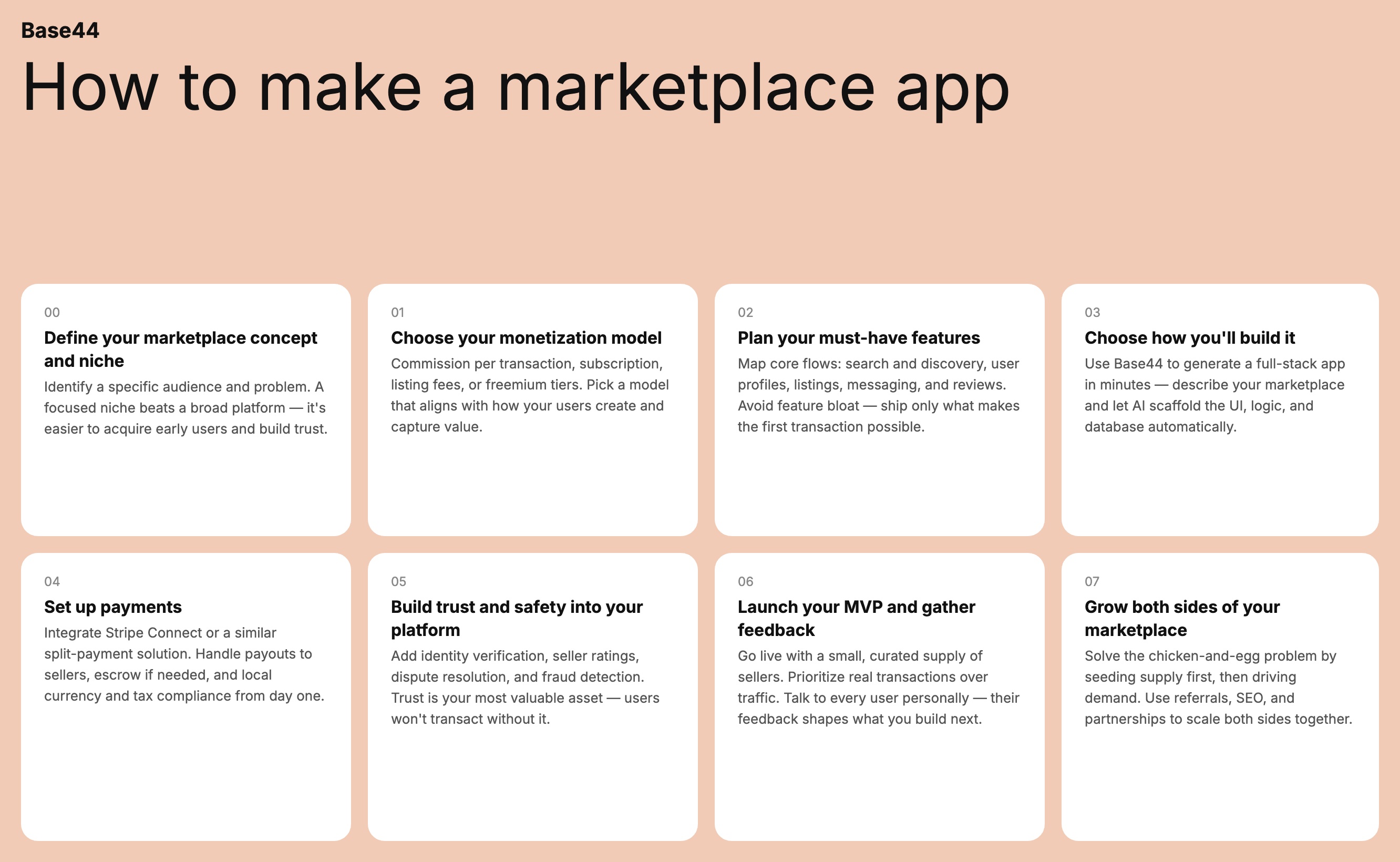
How to make a marketplace app in 8 steps
Here's the full process, from concept to launch.
- Define your marketplace concept and niche
- Choose your monetization model
- Plan your must-have features
- Choose how you'll build it
- Set up payments
- Build trust and safety into your app builder
- Launch your MVP and gather feedback
- Grow both sides of your marketplace
01. Define your marketplace concept and niche
Start with three questions:
- What products or services will be exchanged?
- Who are your buyers?
- Who are your sellers?
The more specifically you can answer these, the better. Broad marketplaces are expensive to build and nearly impossible to grow from zero. Niche marketplaces think vintage camera gear, local tutors for a specific subject, handmade ceramics grow fastest because word travels within tight communities.
Your niche also determines your trust requirements, your payment flow and which features matter at launch. A freelance marketplace needs portfolio tools and messaging. A resale marketplace needs condition ratings and shipping integration. Don't try to build for every use case but pick one, do it well, and expand later.
02. Choose your monetization model
The five main marketplace monetization models are:
- Commission/transaction fee (the platform takes a percentage of each sale)
- Subscription (sellers pay a recurring fee for access)
- Freemium (basic access is free; premium features are paid), listing fee (sellers pay per item listed)
- Advertising (sellers pay for featured placement).
Commission is probably the right starting model for most first-time builders as it aligns your revenue with your sellers' success, requires no upfront payment from sellers and is straightforward to explain and implement.
Start with a single model and validate it before layering on anymore complexity. A subscription plus commission model might maximize revenue eventually
but it will slow your early seller acquisition significantly.
03. Plan your must-have features
Keep your MVP feature list ruthlessly lean on purpose. Every feature you add before launch is a feature that delays launch. Plan three surfaces:
- Buyer side: Listings with photos and descriptions, search and filter tools, secure payment, ratings and reviews, order tracking.
- Seller side: Storefront or profile, inventory management, order dashboard, payout settings.
- Admin: Content moderation tools, basic analytics, dispute resolution flow.
Everything else, wish lists, social sharing, loyalty programs, advanced analytics, belongs in version two. Ship the minimum that makes one successful transaction possible and let real user behavior tell you what to build next.
04. Choose how you'll build it
Traditional development gives you full control and unlimited flexibility but also costs $20,000–$300,000+, takes 6–12 months minimum and requires a technical co-founder or agency to manage.
For founders who want to validate fast without a dev team, AI-powered app builders are now a serious alternative. Base44 lets you describe your app, generate the full structure, customize layouts and logic, connect your backend and launch all without code. You can learn more about how to build an app without coding with our guide.
Base44 is a platform that closes the gap between imagination and execution by turning rough conversational prompts into structured fully functional products.
Explore app ideas to see what's been built with no-code tools before committing to an approach.
If you need to validate whether your marketplace idea works before raising money, a no-code build gets you there in weeks at a fraction of the cost. If you already have funding and a specific technical requirement, custom dev may be the right path.
05. Set up payments
Multi-party payment processing is the technical heart of a marketplace. For example, Stripe Connect is the standard for this. Buyers pay the platform and the platform routes a portion to the seller's connected account. You hold the commission and the seller receives the rest. This model gives you full visibility into every transaction and simplifies reconciliation.
Seller onboarding must include KYC (Know Your Customer) verification, Stripe handles this automatically when sellers connect their accounts. Set clear expectations upfront: how and when sellers are paid, what the commission rate is, and what your refund policy covers. Trust failures in payments are the fastest way to lose both sides of your marketplace at once.
Base44's built-in Stripe integration handles standard checkout, which covers single-seller sales cleanly. For true multi-party payouts, splitting each sale between your platform and individual sellers, you'll need to build on top of that using Base44's backend functions to call Stripe Connect's API directly. This is more technical than the standard integration, so budget extra time for it or bring in developer help for this specific piece.
06. Build trust and safety into your app builder
Trust is the hardest thing to earn and the easiest to lose and build it into your platform from day one rather than retrofitting it after your first bad actor incident.
Core trust features:
- Verified seller badges (linked to completed KYC)
- A two-way ratings and reviews system (both buyers and sellers can be reviewed), escrow-style payments that protect buyers until delivery is confirmed
- A clear dispute resolution flow with defined timelines. Content moderation should combine AI flagging for obvious violations with a human review queue for edge cases.
- A transparent refund policy, displayed prominently at checkout, reduces pre-purchase anxiety significantly.
07. Launch your MVP and gather feedback
Launch to a small, specific audience first and not the whole market. Your goal at launch isn't scale, it's to facilitate one successful transaction and learn everything you can from it.
Learn more about how to make an app prototype to get started.
Recruit your first ten buyers and ten sellers directly and then watch every step of their experience. Talk to them before and after.
Collect qualitative feedback weekly in the first month: what confused people, what slowed them down and what almost made them leave. Quantitative metrics matter too, these include conversion rate, time to first transaction, drop-off points but in the early stage, a 30-minute user interview is worth more than a week of analytics.
08. Grow both sides of your marketplace
Growing a marketplace means growing supply and demand simultaneously, which is harder than growing a single-sided product. Proven tactics: referral programs with incentives on both sides, first-transaction credits to reduce buyer friction, and a supply-first growth strategy where you onboard sellers into a waitlisted network before opening to buyers. For deeper tactics, see our guide on retail app development which covers many of the same growth dynamics.
Track buyer and seller metrics separately: gross merchandise value (GMV), fill rate (the percentage of requests matched to supply), customer acquisition cost (CAC), lifetime value (LTV), and retention rate. A healthy marketplace should show improving fill rate and rising LTV over time as those are your leading indicators that network effects are beginning to work.
This is a long article and only part of it is shown here. Read the full article on iCARE.